Day 7 - Dec 11
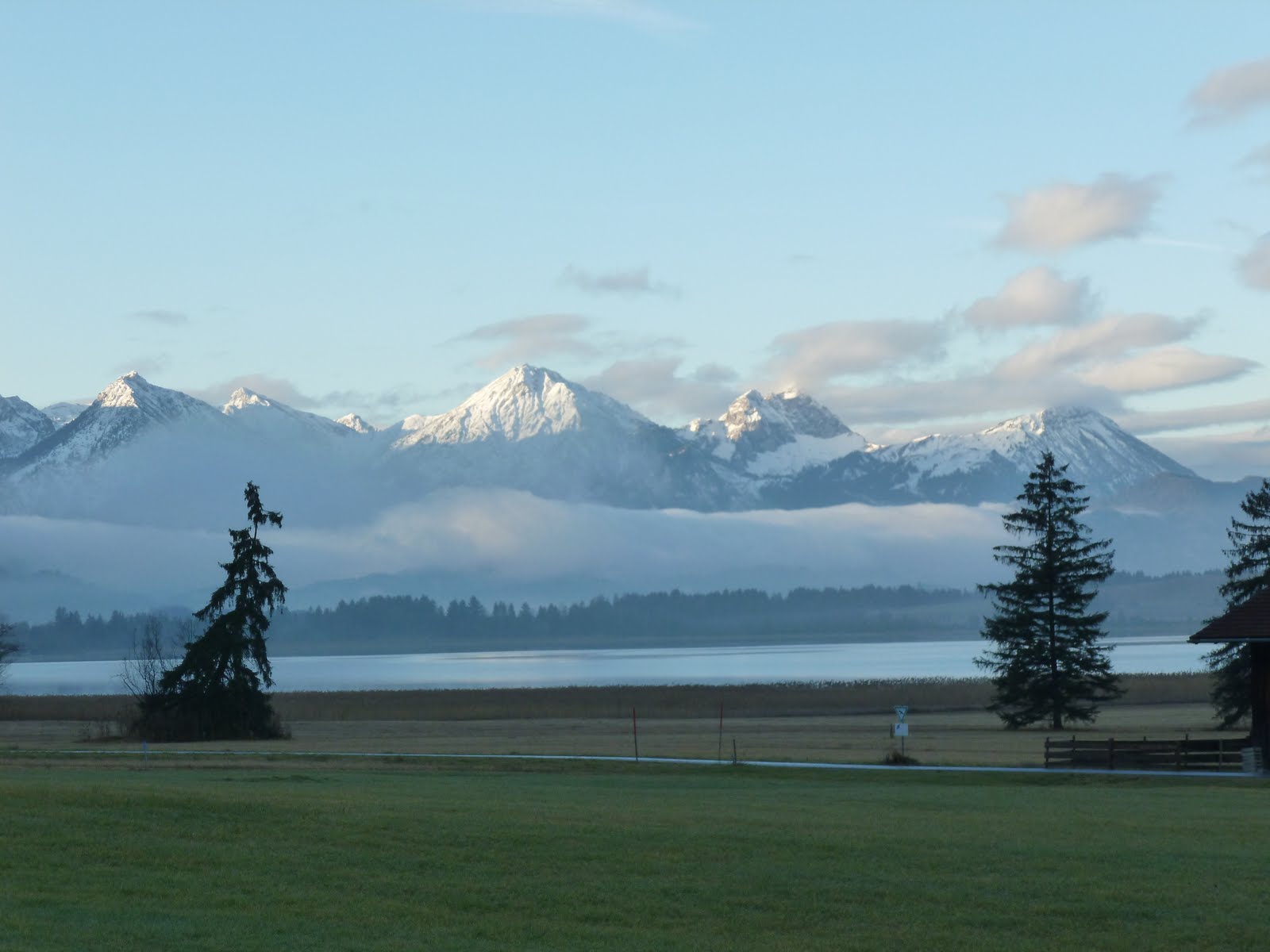
As we were heading out of Fussen early Sunday morning we luckily had clear skies and got some really great shots of the northern Alps in Southern Germany and Austria. Since our flight out of Munich airport wasn't until 8 pm we decided to make a few stops on our drive from Fussen.
 |
| Alp view outside of Fussen |
 |
| Yuka excited |
 |
| Me excited |
Our first stop was to be a small church called Wieskirche. This place is in the middle of nowhere, and it made for a pleasant drive through snow-covered hills and it was very foggy. The history behind the church's creation is interesting... Apparently someone noticed tears coming from a wooden statue of Christ (something to do with the flagellation of Christ {he had gas?}) and the statue became a place of pilgrimage. Apparently the small chapel built there wasn't large, or magestic, enough so in the 1740s the present day structure was erected. The style is called Rococo and it seems the idea behind the style was minimalism on the exterior and extremely non-mininalistic on the interior. Unfortunately, we weren't allowed to take photos inside, so check out the wiki link if you're interested.
http://en.wikipedia.org/wiki/Wies_Church
 |
| Drive to Wieskirche |
 |
| Drive to Wieskirche |
 |
| Drive to Wieskirche - It got really foggy as we got closer. |
 |
| Wieskirche |
 |
| Wieskirche - These chickens chased us (Yuka) off |
After doing some searching for things to see around Munich, we decided to visit the Dachau concentration camp. We knew before going that this wouldn't be an enjoyable trip, but we decided it would be good for us to see some of the more sobering parts of Germany. The village of Dachau is located several miles north of Munich and is the sight of the longest operating concentration camp in Nazi Germany. Dachau was the first official Nazi concentration camp, and served as the model camp for numerous future Nazi concentration and extermination camps.
The site was free to the public and even included numerous language tours. The tour was excellent and quite long, lasting 2.5 hours. Dachau wasn't the largest concentration camp by far, having (officially) only been the place of ~32,000 deaths compared to Auschwitz with somewhere between 2.5 and 4 million deaths, but it was still sobering. I'm not really sure what else to say about the camp other than it's crazy to think that people could really do such a thing on such a massive scale. If you want to read more I've included a wiki link.
http://en.wikipedia.org/wiki/Dachau_concentration_camp
 |
| Main gate into Dachau |
 |
| Roll call area - up to 40,000 people were on roll call in this area. |
 |
| Site where the barracks were. 2 sample barracks were rebuilt in later years, as the original buildings were destroyed to prevent disease. |
 |
| Foundations of the prisoner's quarters |
 |
| Jail cells on the left and administration buildings on the right. |
In the picture above, there is a wall behind me where Nazis killed prisoners by firing squad. To guard the prisoners, the camp had over 1500 SS troops stationed here. The tour guide said that many of these men returned to their normal lives after the war without having been prosecuted or punished. I did a little research after getting home and was happy to hear that the liberating US 42nd and 45th Army Infantry divisions were able to eliminate 600 SS troops by firing squad on the same walls. After the war, General Patton became governor of Bavaria and appropriately pardoned any US soldiers involved. Good.
I was also happy to hear that the US military made every single person living in the area walk through the camp and see the dead bodies piled up, see the crematorium and dig graves for the dead. According to military historians, most locals claimed to have no knowledge of what happened in the camp which I'm sure was complete bullshit given the fact that the camp was right next to the town, was there for 13 years and there were 1500 German soldiers stationed there...
 |
| Crematorium. |
 |
| 'Killing Zone' Prisoners stepping onto the grass would be shot. It was common for prisoners to commit suicide this way or by jumping into the electrified fence |
After the sobering experience, we hopped in the rental car and headed for the airport and the end of a very successful and enjoyable trip. To cap it all off, we were able to enjoy one last German Hofbrauhaus beer while waiting for our flight. Thanks for reading.
 |
| It was a good trip |